

From hardware to revenue
Modern hardware companies use Hardfin to operate more smoothly, deliver better customer outcomes, and unlock end-to-end reporting.
Built for the unique challenges of hardware-as-a-service (HaaS). Operations and finance are finally on the same page.
Trusted by industry leaders managing 100,000+ devices
The Hardfin platform
Whether you're launching your first hardware-as-a-service program, getting a handle on growing success, or looking to scale globally, Hardfin upgrades the experience for your customers and your team.
Hardfin: The operating system for hardware-as-a-service
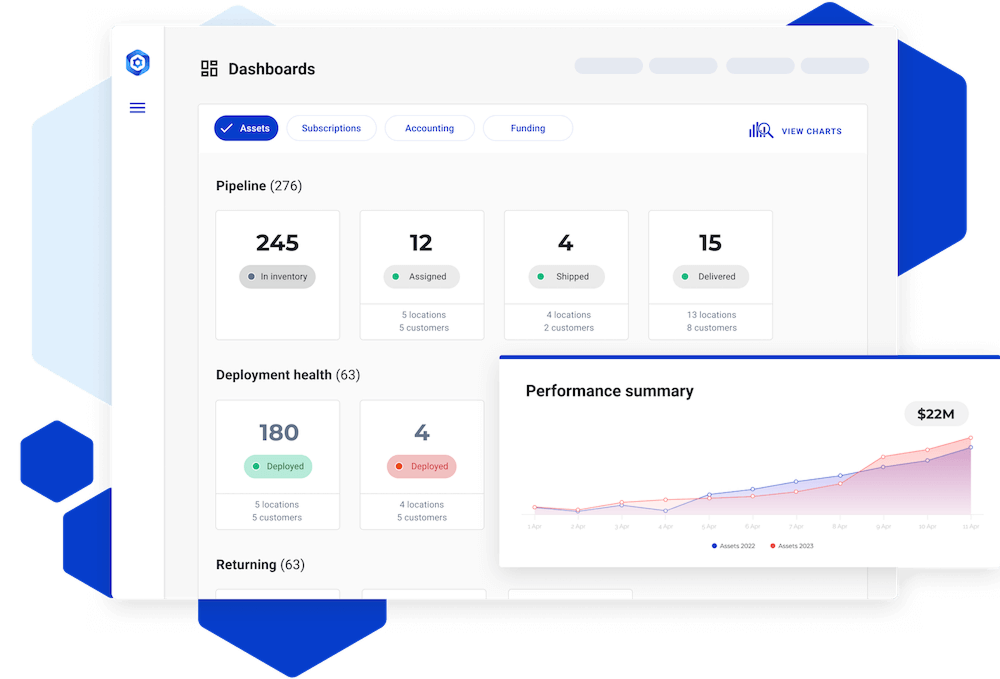
Hardfin is the command center for modern hardware companies. A purpose-built platform to connect systems, teams, and workflows from signature to success. With operations aligned on a shared experience that gives full visibility, Hardfin customers move faster, run more intelligently, and make better decisions.
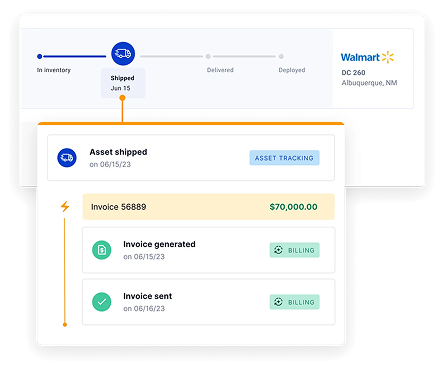
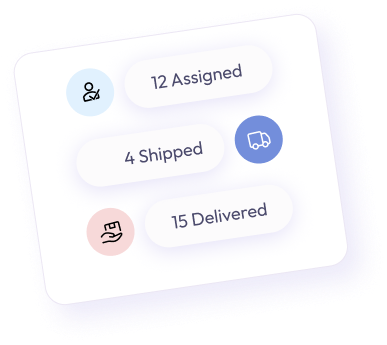
Track every asset, project, and process — all in one place
Unify workflows for physical assets, commercial programs, and financial execution:
- Production operations: Track asset readiness, component usage, and BOMs
- Deployment and implementation: Coordinate customer projects to ensure deal success
- Supply chain: Monitor stock levels and coordinate inbound/outbound asset logistics
- Field and service ops: Manage, maintain, and recover assets across locations
- Finance and accounting: Automate data for billing, depreciation, and revenue
Best-in-class platform to connect siloed systems and coordinate teams... without manual spreadsheets and custom processes.
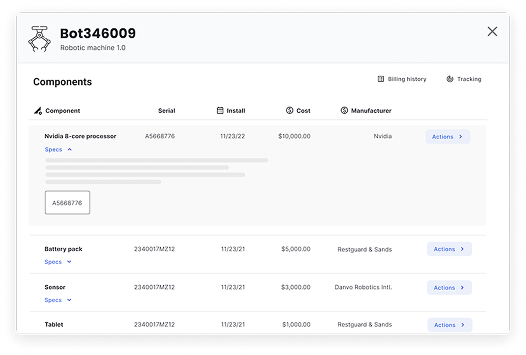
Accelerate execution, improve results, and reduce risk
Hardfin gives teams clear next steps and shared context:
- Launch builds, deploy assets, and start delivering faster
- Minimize manual work across operations and finance
- Bill and account for assets and projects without delays
- Maintain clean audit trails for every event and transaction
The result is faster time to value for customers and reduced execution risk for the business — resulting in significant time and cost savings.
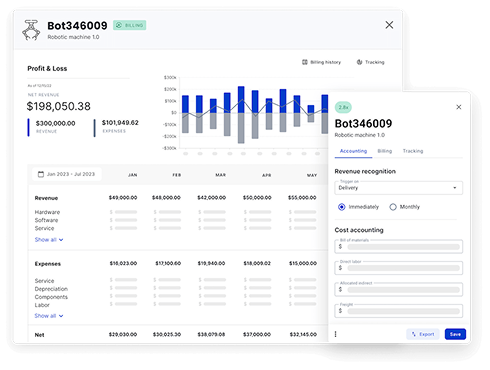
Purpose-built for operations, finance, and customer teams
Hardfin is designed for leaders in operations (manufacturing, supply chain, deployment), finance (billing, accounting, FP&A), and customer (field, success, service) roles. We enable:
- Production ops to manage what’s sourced and what's built
- Supply chain to coordinate logistics and warehousing
- Field ops to handle installs and service
- Customer success to manage program performance
- Finance and accounting to report and audit with confidence
Whether you're executing in the field or running reports at headquarters, Hardfin gives your team the visibility and tools to move fast.
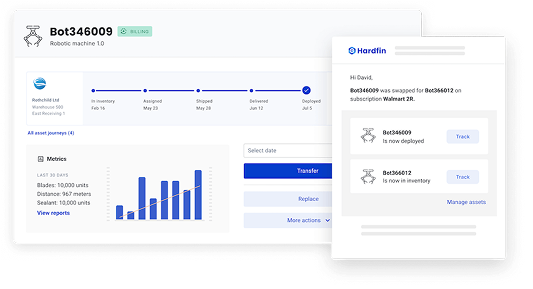
Scale your business off spreadsheets and point solutions
Hardfin is a best-in-class solution for hardware companies looking to systematize operations and scale from the first $100 to the first $100,000,000 deal.
- Align your team and gain control without layering on dozens of point solutions
- Replace ad hoc processes and spreadsheets with repeatable workflows
- Grow from from foundational operations to advanced reporting
- Leverage existing CRM and ERP with native integrations
Our team also provides professional services and advisory support for companies across industries and at any level of maturity.
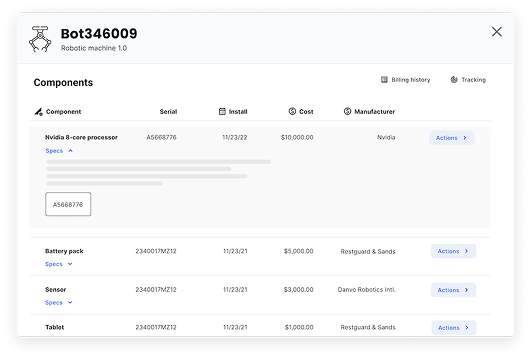
Legacy ERPs only handle narrow business models
1. Build
2. Sell
3. Deliver
4. Invoice
Hardfin is purpose-built for modern hardware companies
Subscribe
Prepare
Deploy
Track
Service
Report

Stay up to date with expert content

HaaS 100 (late January 2026)

HaaS 100 (early January 2026)
.png)
Calculating a LTV:CAC ratio correctly for hardware-as-a-service (HaaS)
Executive testimonials
Frequently asked questions
Hardfin is software for hardware financial operations. It tracks the operational lifecycle of physical assets and enables automated data reporting for financial systems.
Hardfin serves as a complete asset subledger for companies offering “hardware subscription” business models, sometimes called hardware-as-a-service (HaaS).
If a CRM manages the sale and ERP manages the books, Hardfin manages everything in between:
CRM → Hardfin → ERP
The Hardfin platform handles tracking deployment, asset lifecycle, subscription tracking, revenue alignment, and all the operational data that finance depends on. It is purpose-built for hardware-intensive, subscription-based businesses that need operational truth to drive financial accuracy.
Hardfin supports the entire operational lifecycle of revenue-generating hardware assets:
- From sourcing to assembly
- From order to shipment
- From configuration to deployment
- From in-service tracking to changes and swaps
- From returns and redeployments to end-of-life
It creates a single operational source of truth that finance can rely on for billing accuracy, revenue alignment, and reporting.
No. Hardfin does not replace CRM, ERP, or accounting systems.
CRM manages pipeline, accounts, and sales activity. ERP and accounting systems manage the general ledger, payables, and integrated financial reporting.
Hardfin sits between them — managing the operational lifecycle of revenue-generating hardware assets so that what is sold and deployed is accurately reflected in financial systems.
Hardfin serves as a complete asset subledger for companies offering “hardware subscription” business models, sometimes called hardware-as-a-service (HaaS).
Yes. Hardfin is designing to handle billing for hardware subscription and lifecycle-driven revenue models such as hardware-as-a-service (HaaS).
Hardfin generates billing records based on real-world asset state, deployment timing, swaps, usage, and lifecycle changes. It ensures invoices reflect operational reality, not static contract assumptions.
For hardware-as-a-service and asset-backed recurring models, Hardfin is the billing engine that aligns operations and finance.
Note: The billing module is optional. If your team prefers to bill out of a different system, Hardfin can be used as a standalone asset subledger for asset operations and asset accounting, without the need to migrate your billing into Hardfin.
Hardfin is built for hardware companies operating recurring or lifecycle-driven models. Hardware-as-a-service (HaaS) models are growing across industries — including robotics, industrial equipment, medical devices, sensor systems, agriculture tech, computer equipment, and many other device-driven businesses.
Hardfin supports companies across all of these industries. Our platform is particularly valuable for companies transitioning from selling units to subscription, usage-based, or HaaS models. And for companies scaling up their subscription models.
Hardfin works with companies that offer “full subscription” HaaS (retain ownership of your units and charge fees over time) and “hybrid subscription” HaaS (sell your units outright but charge for software/services alongside the hardware).
Hardfin is used by cross-functional teams:
- Supply chain teams managing inventory and logistics
- Operations teams managing deployments, swaps, and field activity
- Customer teams managing service, support, and success
- Finance teams responsible for billing accuracy and revenue reporting
- Accounting teams who need asset accounting and depreciation records
- FP&A leaders who need asset-level insight
- Executives understanding operations and financial performance
Hardfin creates shared visibility across departments that historically operate in separate systems.
We’ve found that our clients usually start with a core stakeholder in Operations or Finance that adopts the platform. Other teams grow into the platform over time.
Hardfin is designed for companies that have outgrown ad hoc systems but are not served well by generic enterprise software.
Typically this includes:
- Growth-stage hardware businesses
- Device makers transitioning to recurring models
- Businesses expanding to a new business model or geography
- Established operators looking to modernize lifecycle visibility
- Companies struggling with disparate systems and custom connectors
The common trait is operational complexity tied to financial performance. We support small teams tracking their very first asset, all the way up to large enterprises tracking more than 100,000 assets.
Yes. Hardfin is a secure, cloud-based SaaS platform that integrates with enterprise systems. Hardfin is designed to support both high-growth companies and established enterprises operating complex hardware models.
Our platform is hosted on enterprise cloud infrastructure. Security, role-based access, and auditability are core to the platform because operational data feeds financial outcomes.
Our engineering leadership has scaled real-time data systems to millions of users, billions of dollars, and trillions of data points. Hardfin is designed to support both high-growth companies and established enterprises operating complex hardware models.
Hardfin supports any business model with two key ingredients: (1) hardware units/device and (2) recurring software/service/support.
This includes:
- Hardware-as-a-service (HaaS) - fully owned assets that are rented or leased
- Hybrid sales (units sold to customers) plus recurring software or service
- Subscription and usage-based models
- Lease-like and managed-service structures
- Hardware-enabled SaaS
Sometimes these business models have industry-specific names:
- Machine-as-a-service (MaaS)
- Device-as-a-service (DaaS)
- Equipment-as-a-service (EaaS)
- Robotics-as-a-service (RaaS)
- Network-as-a-service (NaaS)
If revenue depends on deployed assets over time, Hardfin is designed to support the inherent complexity of your business model.
Hardfin is built to manage complex hardware+software business models at scale.
We supports serialized assets, swaps, redeployments, partial billing, project-based deployments, usage-based models, hybrid structures, and much more.
If revenue depends on asset lifecycle events, Hardfin is designed to model and manage it. If you have a question about your specific asset, business, accounting or revenue model, please contact us to discuss!
Hardfin is designed to support business model evolution.
As companies move from sales to subscriptions, introduce usage pricing, or launch new service offerings, Hardfin adapts the operational model without requiring a new system.
The Hardfin platform is built for companies that are scaling and iterating — not for static legacy businesses.
No. Hardfin works alongside your existing CRM and ERP.
It does not replace your accounting system or general ledger. Instead, it ensures operational events are accurately reflected in those systems.
Hardfin is a complete asset subledger for your operating assets. The Hardfin platform strengthens your existing stack rather than displacing it.
Hardfin sits between CRM and ERP.
- Your CRM captures what was sold
- Hardfin instantly syncs your closed deals to tee up implementation/deployment for customer engagements
- Hardfin manages and records day-to-day operational reality — assets, deployments, changes
- Hardfin financial reporting generates official subledger summaries of asset activity
- Your ERP records financial outcomes as part of the complete general ledger (GL)
Hardfin is the operational layer that ensures lifecycle activity translates correctly into financial truth.
Hardfin connects with leading CRM, ERP, and operational systems to synchronize data in real time.
It is designed to easily integrate:
- Ingest sales and customer data (CRM)
- Sync billing and accounting outcomes (ERP)
- Connect to warehouse, logistics, and other operational systems (3PL)
- Record IoT signals and metrics (IoT)
- Track service events and outcomes (ticketing)
- And many more
The goal is alignment across your stack, not duplication.
Implementation is structured and guided by our in-house experts on hardware-as-a-service (HaaS) and system integration.
Hardfin’s onboarding process is designed specifically for hardware businesses, not generic SaaS implementations. Most customers begin by consolidating asset, deployment, and contract data into a unified model.
The onboarding effort varies widely depending on the complexity and fragmentation of your current data, systems, and implementation. We make every effort to streamline manual reconciliation and automate every process.
We’ve had customers onboard spreadsheet-driven systems as quickly as 1 week, and have had deep ERP integration buildouts take as long as 4 months. The typical time to collect files, standardize data, integrate systems, onboard workflows, train team members, and go live is 3-6 weeks.
Customers typically see initial visibility improvements within days. Operational and billing alignment benefits are apparent in the first few weeks.
Full lifecycle and reporting optimization depends on complexity, but value is usually tangible in the first 30-60 days. Particularly in reduced reconciliation effort and improved asset clarity during the first accounting close after implementation.
Most implementations start with:
- Customer and contract data
- Product (SKU) and asset (serial) records
- Deployment and location history
Many expand to:
- Accounting details and rules
- Billing structure and pricing logic
- Time and cost tracking reports
Hardfin’s native connectors for populate CRMs and ERPs make it lightning-fast to pull in structured data. Our API makes the platform flexible to onboard any pre-existing data model.
If the data exists somewhere — even scattered across systems and spreadsheets — our expert team can connect, consolidate, and map your business into an organized HaaS model. Usually within days or weeks.